
Unfortunately, many of the factors are poorly known, so estimates of N range from one (we are alone in the Galaxy) to thousands or even millions. As you may imagine, there is a lot of debate about reasonable values for most of these factors. As we learn more about the the star systems in our galaxy and the likelihood of planets around those stars, we would be able to better estimate these parameters. Drake's own current solution to the Drake Equation estimates 10,000 communicative civilizations in the Milky Way.
There is actually a second version of Drake's equation. In that pitch by Gene Roddenberry mentioned earlier, Roddenberry didn't have the equation with him, and he was forced to "invent" it for his original proposal. The invented equation created by Roddenberry is:

Drake later pointed out, however, that a number raised to the first power is merely the number itself. A poster with both versions of the equation was seen in the Star Trek: Voyager episode "Future's End".

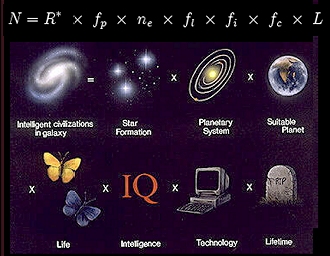
R = The rate of formation of suitable stars
(stars such as our Sun)
fp = The fraction of those stars with planets
(current evidence indicates that planetary systems may be common for stars like the Sun.)
ne = The number of Earth-like worlds per planetary system
fl = The fraction of those Earth-like planets where life actually develops
fi = The fraction of life sites where intelligence develops
fc = The fraction of communicative planets (those on which electromagnetic communications technology develops)
L = The "lifetime" of communicating civilizations
