Has Earth detected any signals from beyong the solar system yet? Not conclusively. There have been interesting "candidate" signals found. The Ohio State Big Ear radio telescope made history in August 15th, 1977 by detecting an extremely strong, narrowband radio signal that, after ruling out terrestrial sources and known artificial satellites, bore expected hallmarks of potential non-terrestrial and non-solar system origin. Astounded at how closely the signal matched the expected signature of an interstellar signal, the researcher who detected it - Dr. Jerry R. Ehman - circled the signal on the computer printout of the results and wrote the comment "Wow!" on its side. The signal lasted for exactly 72 seconds and is thought to have originated from a region of the sky in the constellation Sagittarius, roughly 2.5 degrees south of the fifth-magnitude star Chi-1 Sagittarii.
The "Wow" signal remains the most intriguing clue to intelligent life beyond our solar system, but it has not been heard again since.

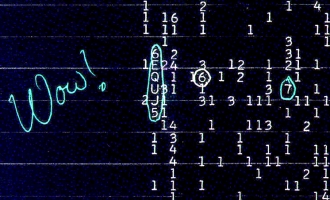
The Wow" signal: The circled letter code 6EQUJ5 describes the intensity variation of the signal. The value 'U' (an intensity between 30.0 and 30.999) was the highest ever detected by the Big Ear telescope.
