
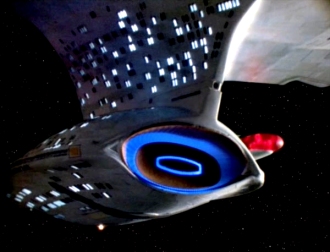
A ship travelling at faster-than-light warp velocities will obviously face a significant threat of damage caused by collisions with interstellar particles or debris. Even the tiniest particle can cause considerable damage if it strikes the ship's hull at faster-than-light speed. In Star Trek, the Deflector Dish (also called the Navigational Deflector System) is dish-shaped force beam generator that deflects such particles away from the ship's hull. Located at the forward end of the vessel's secondary hull, its subspace field coils emit a series low-power parabolic shields to deflect small particles. Higher-powered deflector or tractor beams direct an accurate and powerful beam to push aside larger objects (such as asteroids).
However, NASA scientists are now investigating using powerful electric fields to offer protection from an equally lethal space hazard - radiation. As with the Star Trek navigational deflectors, electrostatic fields would be generated with the same charge as the incoming radiation, thus deflecting the radiation away. The system would have half dozen or so inflatable, conductive spheres about 5 meters across, charged up to a very high static-electrical potential of 100 megavolts or more. The spheres would be made of a thin, strong fabric (such as Vectran), coated with a very thin layer of a conductor such as gold.


The electrostatic radiation shield would consist of
positively charged inner spheres and negatively
charged outer spheres.