|
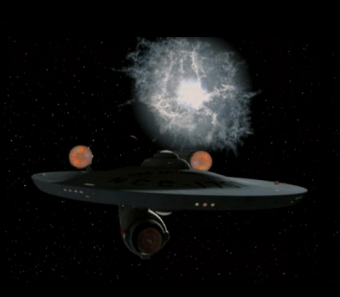
A supernova is a massive explosion that occurs upon the
death of an old star. When a massive star runs out of nuclear fuel, the
star collapses under gravity. The resulting shock wave blows the outer
layers of the star into space, possibly leaving a core that becomes
either a neutron star or a black hole, depending on the remaining mass.
A different kind of supernova occurs (more rarely in our Milky Way
Galaxy) when a white dwarf star in a tight binary system swallows
material from her companion, eventually becoming too massive and
collapsing.
In Star Trek, supernova which occurred 600,000 years
ago, during the Age of Makto, was responsible for the fall of the Tkon
Empire. (TNG: "The Last Outpost"). In 2366, the star Beta Stromgren
exploded as a supernova. The last stages of the star's life were
observed by the USS Enterprise-D while taking first contact with the
creature Gomtuu. (TNG: "Tin Man")
As of the 24th century, only three Starfleet vessels
ever witnessed supernovae firsthand. The record for the closest
observation was less than 10 billion kilometers and was set by the USS
Voyager in 2373. A number of supernovae occurred within a small region
of the Delta Quadrant, as a result of the Q Civil War. These supernovae
were actually the result of spatial disruptions within the Q Continuum.
The crew of Voyager, acting on information provided by the female Q,
used the explosion of one of these supernovae to enter the Continuum
themselves, in order to rescue Q and Captain Janeway. (VOY: "The Q and
the Grey")
In the Alpha Quadrant, the Changeling posing as Doctor
Julian Bashir attempted to trigger a supernova in the Bajoran sun using
trilithium, tekasite and protomatter. The Founder was stopped by Kira
Nerys, Jadzia Dax and the crew of the USS Defiant. (DS9: "By Inferno's
Light").
In the real universe, supernovae are the death explosion
of certain types of star, resulting in a sudden, vast increase in
brightness followed by a gradual fading. They are extremely luminous
and cause a burst of radiation that often briefly outshines an entire
galaxy before fading from view over several weeks or months. During
this short interval, a supernova can radiate as much energy as the Sun
could emit over its life span.
Several types of supernovae exist that may be triggered
in one of two ways, involving either turning off or suddenly turning on
the production of energy through nuclear fusion. After the core of an
aging massive star ceases to generate energy from nuclear fusion, it
may undergo sudden gravitational collapse into a neutron star or black
hole, releasing gravitational potential energy that heats and expels
the star's outer layers. Alternatively, a white dwarf star may
accumulate sufficient material from a stellar companion to raise its
core temperature enough to ignite carbon fusion, at which point it
undergoes runaway nuclear fusion, completely disrupting it. Stellar
cores whose furnaces have permanently gone out collapse when their
masses exceed the Chandrasekhar limit, while accreting white dwarfs
ignite as they approach this limit (roughly 1.38 times the mass of the
sun). White dwarfs are also subject to a different, much smaller type
of thermonuclear explosion fueled by hydrogen on their surfaces called
a nova. Solitary stars with a mass below approximately nine solar
masses, such as the Sun itself, evolve into white dwarfs without ever
becoming supernovae.
Supernovae are the primary suppliers of heavy elements
for the universe nucleosynthesis. Elements necessary for life, such as
carbon and oxygen, as well as heavier elements like iron, are produced
by nucleosynthesis within the star. In the explosive death of the star,
these elements are thrown out so that they may be recycled by other
stars and gases. The amount of heat and pressure released from a
supernova explosion may create new regions of star birth by compressing
the surrounding interstellar medium. In addition, supernovae are used
as light beacons to measure cosmological distances. Important as they
are, few supernovae have been observed in our own galaxy. The last one
in our galaxy exploded in 1604 and was observed by Johannes Kepler
before the invention of the telescope.
|
|

