A History of the Malay Peninsula
Portuguese Conquest
The Johor Empire
Dutch East India
The Straits Settlements
The Kedah Blockade
The Selangor Civil War
The Perak War
|
 The Kedah Blockade The Kedah Blockade
Since before the days of the Melaka Sultanate, the Malay States of the northern peninsula - Patani, Kedah, Kelantan, Trengganu and Perak - had always been considered by Siam as its tributaries. However, for centuries the Siamese had been too busy fighting invaders - especially the Burmese - to press its claims on the Malay states and had to be satisfied with only periodically receiving "Bunga Mas" or "Golden Flowers" from the rulers of these states as a symbolic admission of Siamese suzerainty. However, continual Burmese invasions progressively weakened the Siamese, culminating in the sacking and destruction of Ayutthaya in 1767. The Malay States began to exert their independence and now considered their sending of ornamental plants with leaves and flowers of gold merely as a token of long-standing friendship and respect. It was this independent streak, for instance, that persuaded Sultan Abdullah of Kedah to lease Penang to another foreign power - an act that would have no doubt caused some anger in the Siamese court. He may have expected that conceding such a great prize to the British might induce them - as a matter of honour - to offer some protection from his former master in Bangkok. A global power such as Britain would be a formidable deterrent for a weak Siam.
When Patani's Sultan Muhammad was reluctant to send troops to aid Siam face a Burmese invasion, Rama I's son, Prince Surasi, attacked Patani. Sultan Muhammad was slain in battle and 4,000 Patani Malays were brought in chains to Bangkok as slaves.
The subjugation of Patani was an object lesson to Siam's other Malay vassal sates, especially Kedah. In the years 1813, 1816 and 1818, Kedah was forced to supply thousands of soldiers, hundreds of boats and many tons of rice to Siam to help drive away the remaining Burmese in Siamese territory. In 1818, Rama II went as far as ordering Kedah to attack Perak because its Sultan had foolishly not sent "Bunga Mas" to the Siamese court for several years. Kedah's Sultan Ahmad Tajuddin Halim Shah, however, knew the real reason for the order - to weaken both Kedah and Perak so that they could succumb to invasion and direct rule. In the war which ensued, Kedah succeeded in defeating Perak, and the Sultan of Perak was forced to send "Bunga Mas" to the King of Siam.
After occupying Kedah, the Siamese hoped to extend its conquests further south and attacked Perak. However, the Siamese were defeated by the Perak Malays, with the help of Malay and Bugis reinforcements rushed from Selangor. The Sultan of Kedah, in exile in his other lost possession Penang, demanded the British help put him back on his throne. There were many in the British administration and business community in Penang who were sympathetic to the Sultan's cause - both as a matter of honour and because of fear of further Siamese encroachment on the peninsula and in trade. But the Governor-General in India continued Britain's policy of not engaging in expensive little wars on the Peninsula and refused to do anything about the fate of the wronged Sultan.
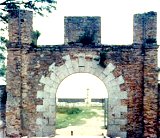
Despite the Burney Treaty, Penang became a hotbed of Malay resistance to the Siamese. The chiefs of Kedah and the relatives of the Sultan gathered there planning their war of liberation, while British merchants and private citizens in Penang eagerly (but covertly) provided them with guns, ammunition, boats and other supplies, in exchange for rice. In 1831, the Sultan's son Tunku Kudin led 3000 Malays out of Prai and drove the Siamese from Kedah. The Siamese declared the rebels as bandits, hunting, torturing and executing them accordingly. Siam's newly-found friends the British declared them pirates and, in the words of the British historian R O Winstedt, "to Britain's shame, British gunboats blockaded the Kedah coast". Facing a Siamese army of 7,500 men and 3,000 elephants, Ku Din was driven back and cornered in Kuala Kedah fort. After a bloody siege lasting three months, the fort was stormed and Ku Din's head was sent to Bangkok. Over 16,000 men, women and children fled from the avenging Siamese army into Prai and Penang.
The old Sultan was not about to give up - what he could not win by force of arms, he now tried with shrewd Malay diplomacy. Three years later, Raja Zainal Rashid or Tengku Dai, the Sultan's eldest son, went to Bangkok to have frank discussions with the King, Rama III. Tengku Dai offered him acceptance of Siamese suzerainty - if they restored the throne of Kedah to the Sultan. Rama III consented - with growing pressures from British and French 'farang' in other parts of his kingdom, Siam desperately needed to put a stop to these constant Malay rebellions.
As for the British, they'd had their first taste of military intervention on the Peninsula - and it had not been a wholly unpleasant outcome for British interests in the region. They were not to be too reticent when, thirty years later, it became necessary to send the gunboats in again. |
Kedah's last stand
A British Midshipman's account of the Blockade
Kuala Kedah fort
Kedah's bastion of independence
The Kedah Disturbances
From J T Thomson's Glimpses Into Life in Malayan Lands
The End of Langakasuka
|
|---|
Write to the author: sabrizain@malaya.org.uk
| The Sejarah Melayu website is
maintained solely by myself and does not receive any funding
support from any governmental, academic, corporate or other
organizations. If you have found the Sejarah Melayu website useful, any
financial contribution you can make, no matter how small, will be
deeply appreciated and assist greatly in the continued maintenance of
this site. |


 However,
things were to change dramatically for Siam - and the Malay
states. The Siamese general Phraya Taksin led a war of independence
that drove the Burmese out of Siam and his successor Rama I established
the Chakri dynasty, which was to rule Siam to this day. After throwing
back another massive Burmese invasion in 1785, a resurgent Siam turned
its attention to its increasingly insubordinate southern subjects.
However,
things were to change dramatically for Siam - and the Malay
states. The Siamese general Phraya Taksin led a war of independence
that drove the Burmese out of Siam and his successor Rama I established
the Chakri dynasty, which was to rule Siam to this day. After throwing
back another massive Burmese invasion in 1785, a resurgent Siam turned
its attention to its increasingly insubordinate southern subjects.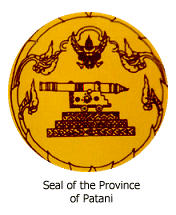 Further
rebellions erupted in Patani in 1791 and 1808, following which
Patani was split into seven provinces and ruled directly under the Raja
of Ligor (Songkhla). The Malay state that had begun its life as that
ancient kingdom of myth and legend, Langkasuka, was no more.
Further
rebellions erupted in Patani in 1791 and 1808, following which
Patani was split into seven provinces and ruled directly under the Raja
of Ligor (Songkhla). The Malay state that had begun its life as that
ancient kingdom of myth and legend, Langkasuka, was no more. In
1821, the King of Siam invited the Sultan of Kedah to Bangkok to pay
homage to him. But the shrewd Sultan refused, fearing assassination. To
punish
the Sultan for this personal affront, a large Siamese fleet sailed into
Kuala Kedah, massacred the garrison there and sailed on to Kuala Merbok
looking for the Sultan. The Sultan fled to Seberang Prai, scattering
coins from his elephant to delay his pursuers, and sailed to Penang,
where the Governor allowed
him to take refuge - much to the annoyance of the Siamese. As it did
with
Patani, Siam partitioned Kedah into four separate territories - Kedah,
Perlis,
Setul (Satun) and Kubang Pasu, each under a raja chosen by Siam and
subject
to Siam. Kubang Pasu was returned to Kedah decades later but, to this
day,
Perlis remains an independent state and Setul remains in Thai territory.
In
1821, the King of Siam invited the Sultan of Kedah to Bangkok to pay
homage to him. But the shrewd Sultan refused, fearing assassination. To
punish
the Sultan for this personal affront, a large Siamese fleet sailed into
Kuala Kedah, massacred the garrison there and sailed on to Kuala Merbok
looking for the Sultan. The Sultan fled to Seberang Prai, scattering
coins from his elephant to delay his pursuers, and sailed to Penang,
where the Governor allowed
him to take refuge - much to the annoyance of the Siamese. As it did
with
Patani, Siam partitioned Kedah into four separate territories - Kedah,
Perlis,
Setul (Satun) and Kubang Pasu, each under a raja chosen by Siam and
subject
to Siam. Kubang Pasu was returned to Kedah decades later but, to this
day,
Perlis remains an independent state and Setul remains in Thai territory. When
war broke out between the British and the Burmese in 1824, this
policy shifted dramatically - though not in the Sultan's favour.
Britain now saw Siam as a possible ally in their war. By 1826, Captain
Henry Burney concluded a treaty with the Siamese government where the
British promised not to interfere in the affairs of Kedah under the
Siamese. To allay the fears of Penang, the
Siamese on their part promised not to attack Perak and Selangor.
When
war broke out between the British and the Burmese in 1824, this
policy shifted dramatically - though not in the Sultan's favour.
Britain now saw Siam as a possible ally in their war. By 1826, Captain
Henry Burney concluded a treaty with the Siamese government where the
British promised not to interfere in the affairs of Kedah under the
Siamese. To allay the fears of Penang, the
Siamese on their part promised not to attack Perak and Selangor. 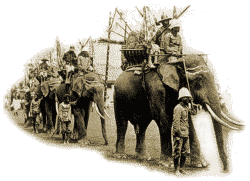 Another
Malay attack in 1838 not only won them their homeland again but
even managed to take the war to Siamese territory, allowing them to
liberate
Patani and besiege Singora (Songkhla). But as before, heavy
reinforcements
arrived from Bangkok and the Kedah Malays made one final last stand at
Kota
Kuala Kedah. Two hundred men held out to the end, surrounded on land by
15,000 Siamese infantry equipped with modern muskets, artillery and
elephants. At sea, the British 18-gun warship 'Hyacinth' and three
gunboats blockaded the fort. After terrible massacres and atrocities on
both sides, the defenders were overwhelmed and the red flag of Kedah
was finally lowered over the old fort on the morning of March 20th.
Another
Malay attack in 1838 not only won them their homeland again but
even managed to take the war to Siamese territory, allowing them to
liberate
Patani and besiege Singora (Songkhla). But as before, heavy
reinforcements
arrived from Bangkok and the Kedah Malays made one final last stand at
Kota
Kuala Kedah. Two hundred men held out to the end, surrounded on land by
15,000 Siamese infantry equipped with modern muskets, artillery and
elephants. At sea, the British 18-gun warship 'Hyacinth' and three
gunboats blockaded the fort. After terrible massacres and atrocities on
both sides, the defenders were overwhelmed and the red flag of Kedah
was finally lowered over the old fort on the morning of March 20th. In
1843, after 21 years in exile fighting a war of liberation, the
Sultan returned to Kedah to re-assume his position as Sultan of Kedah.
He had lost Perlis and Setul - but he had freed his kingdom from direct
Siamese rule. Kedah was saved from suffering the same fate as Patani
and was to remain a
Malay Sultanate to this day.
In
1843, after 21 years in exile fighting a war of liberation, the
Sultan returned to Kedah to re-assume his position as Sultan of Kedah.
He had lost Perlis and Setul - but he had freed his kingdom from direct
Siamese rule. Kedah was saved from suffering the same fate as Patani
and was to remain a
Malay Sultanate to this day.